
If someone types a random word followed by ".io" into a browser and finds themselves still playing three hours later, they have already experienced the quiet magic of the .io genre. But what exactly turns two lowercase letters into one of the biggest categories in browser gaming — a category that survived the death of Flash, outlasted the first wave of battle royales, and now props up a long list of free-to-play web portals?
This guide breaks down the .io phenomenon end to end: where the name actually comes from, who built the first hit and how, what technology powers modern .io lobbies, and why the loop feels so difficult to put down. It closes with tested picks from the DooDoo.Love catalogue.
What Are .io Games?
The ".io" in .io games is not a marketing invention. It is a country code top-level domain (ccTLD) that was delegated by IANA in 1997 to represent the British Indian Ocean Territory — a cluster of atolls in the middle of the Indian Ocean with no permanent civilian population. Because the letters "I/O" happen to be programmer shorthand for "input/output," the extension was quickly adopted by tech startups looking for a short, memorable domain that sounded technical. GitHub Pages (github.io) and Google's developer conference (Google I/O) were early cultural anchors. By the early 2020s, the registry reported roughly 1.6 million active .io domains, up from around 660,000 in 2021, according to public data cited in Wikipedia's entry on the .io domain.
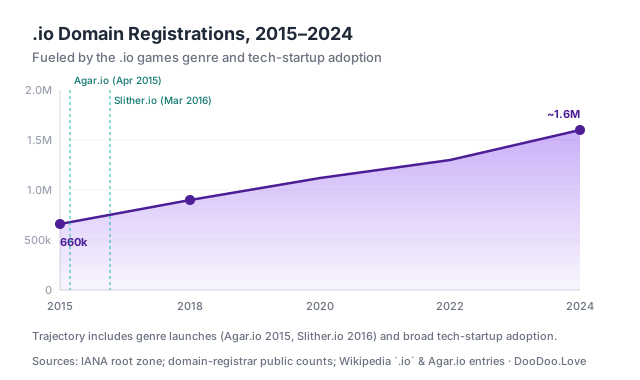 Sources: IANA root zone records · Public domain-count data · Wikipedia — .io · Wikipedia — Agar.io
The gaming association, however, only arrived in 2015 with a single breakout hit. A nineteen-year-old Brazilian developer named Matheus Valadares, operating under the handle "Zeach," built a browser multiplayer game where players controlled a coloured circle that ate smaller circles to grow. He posted a playtest link on the 4chan /v/ board before registering the domain agar.io on April 28, 2015. Feedback and the name itself came from that thread; Valadares never ran a marketing campaign, and within days the game was overwhelming his servers. These details are documented in the Agar.io Wikipedia article and were widely reported in gaming press at the time.
What the Agar.io wave proved is that a specific design recipe, delivered through the URL bar, could out-distribute the traditional app store. That recipe is now the .io formula:
The .io game formula:
- Instant play — no download, no account, no tutorial
- Simple controls — usually just mouse movement plus one or two keys
- Real-time multiplayer — actual humans, not bots, on a shared server
- A growth or power loop — start small or weak, get bigger/stronger by defeating others
- Short sessions — each round runs roughly 2 to 15 minutes
- Permadeath per round — die and start over, with no saved progress
The combination creates a paradox that is now copied across the genre: the barrier to entry is effectively zero, but the skill ceiling is high. A new round starts in roughly three seconds after death, which turns "just one more round" into the single most dangerous sentence in browser gaming.
A Short History of a Two-Letter Genre
The .io ccTLD and the .io genre are only loosely connected. The territory itself has a complicated history — the British Indian Ocean Territory (BIOT) was carved out of Mauritius and the Seychelles in 1965, and the UK announced in October 2024 that sovereignty would eventually transfer back to Mauritius, while retaining the Diego Garcia military base on a long-term lease. That geopolitical shift has prompted periodic "will the .io domain die?" headlines, but IANA processes generally allow multi-year transitions for any ccTLD change, so existing games are not in imminent danger.
The gaming timeline is cleaner:
| Year | Game | Innovation | |------|------|-----------| | 2015 | Agar.io | Created the genre. Cell-eating multiplayer with a shared leaderboard. | | 2016 | Slither.io | Added skill-based movement (snake mechanics) and controllable speed. | | 2016 | Diep.io | Introduced persistent upgrades, tank classes, and PvP arenas. | | 2017 | Surviv.io | First successful .io battle royale, shipping before many native titles. | | 2018 | Krunker.io | Proved .io games could host full 3D FPS experiences in a browser tab. | | 2020 | Social deduction wave | Among Us clones and "hide and seek" variants entered .io territory. | | 2023 | Mature genre | Deeper mechanics, larger lobbies, better anti-cheat. | | 2025-2026 | Current era | HTML5 and WebGPU improvements bring near-native visuals to the browser. |
The second breakout hit is also worth isolating. Slither.io, released on March 25, 2016, was built by American developer Steven (Steve) Howse under the studio name Lowtech Studios. In interviews Howse has explained that he had wanted to build a persistent multiplayer title for years, but considered Adobe Flash the only viable option and was reluctant to use it. He revisited the idea once he confirmed that the WebSocket protocol — a low-latency, bidirectional channel supported by all major browsers — was stable enough to sustain a live server, as summarised in the Slither.io Wikipedia article. After six months of work, Slither.io launched with servers sized for roughly 500 concurrent players per shard, and by the end of 2016 it was Google's most-searched video game in the United States.
The Technology Stack Behind a Modern .io Game
For players, .io games feel like they "just work." Behind the scenes they rely on a small, remarkably consistent technology stack:
- Transport: WebSocket. Virtually every serious .io game uses WebSocket for real-time state sync. It opens a persistent TCP connection between browser and server, which avoids the round-trip overhead of traditional HTTP polling. This is the single enabling technology for the genre — no WebSocket, no modern .io.
- Rendering: Canvas 2D or WebGL. Early Agar.io-era titles rendered with the HTML5
<canvas>2D API, which is simple but capable of drawing thousands of circles per frame. More graphically ambitious titles (Krunker.io, CobraZ.io, many modern shooters) use WebGL, which gives them access to GPU-accelerated 3D rendering directly from the browser. - Engines and tools. Some studios hand-roll their client in JavaScript with frameworks like Phaser or Pixi.js. Others ship Unity WebGL builds, which export a compiled Unity game as a WebAssembly bundle that runs in-browser; this is common for 3D .io titles. A third cluster use GameMaker Studio 2 (GMS2) HTML5 exports or Godot HTML5 builds.
- Servers. The server side is typically Node.js or Go with an authoritative world simulation; physics and hit detection run on the server to discourage client-side cheating. Popular hosting patterns involve regional shards so a player in Frankfurt is not fighting lag against a server in São Paulo.
- Monetisation. The business model is almost always rewarded ads plus cosmetic microtransactions (skins, trails, usernames). There is rarely a purchase price.
This stack matters because it explains why .io games can iterate so quickly compared to app-store titles: a patch is a redeployed JavaScript bundle, not a two-week app-review cycle.
Why Are .io Games So Addictive? (The Psychology)
The stickiness of .io games is not accidental. The formula borrows heavily from behavioural design patterns that academic researchers have studied in casino games, mobile free-to-play titles, and social media apps. Here are the five mechanisms that do the heaviest lifting.
1. Minute-to-Matter Time
Game designers sometimes talk about "time-to-fun" — how many seconds a player has to wait before something interesting happens. .io games aggressively minimise this number. Agar.io's time-to-first-meaningful-action is under ten seconds: landing page, a single click, alive, eating. Compared to the ten-minute install-and-tutorial cycle of a console game, this collapses the commitment a player has to make.
2. The "Near-Miss" Effect
When a bigger player almost catches a smaller one, and the smaller one threads a narrow escape, the brain releases dopamine in a pattern similar to a near-miss on a slot machine. .io games are designed around frequent near-misses — the viewport, the pace, and the growth curves are all tuned so that life-or-death moments occur every 30 to 60 seconds.
3. Visible Progress
Unlike most RPGs, where progress is abstract (numbers on an XP bar), .io progress is physical. The cell grows on screen. The snake gets visibly longer. The tank gets a bigger barrel. The feedback loop bypasses the need to read UI text and slams the reward home through visual size.
4. Emergent Leaderboard Pressure
The always-visible top-10 leaderboard turns an ambient match into a micro-tournament. Seeing "Player_847" at #1 with 50,000 points creates a specific, measurable goal. When a player overtakes someone on that leaderboard, the satisfaction is amplified because they know a real human is watching their number drop.
5. Zero-Friction Restart (Skinner Box Loop)
Behavioural psychology describes a "Skinner box" as a system where a subject can repeat an action and get variable rewards with very low cost per attempt. .io games are unusually pure examples. A round takes minutes. Death is instant. Restart is instant. The average .io session involves dozens of micro-loops where each loop ends in either a small win or a quick reset. The genre has essentially industrialised the "one more round" impulse.
Market Size and Player Data
How big is this genre in practice? A few reference points:
- At its commercial peak in 2015–2016, Agar.io reported about five million daily players and roughly 30 million monthly players after mobile publisher Miniclip took over distribution, with the mobile version eventually passing 113 million downloads in its first twenty months. Those figures have been reported in trade press including PocketGamer.biz and are reflected in Agar.io's Wikipedia entry.
- Slither.io was the most-Googled video game in the United States in 2016, outranking most AAA releases of the same year.
- The broader browser-games ecosystem continues to scale: aggregators such as CrazyGames and Poki serve hundreds of millions of monthly sessions, and .io titles remain a top-three category on those portals.
Individual .io games rise and fall, but the genre's floor keeps climbing as browser performance improves.
Best .io Games to Play Right Now (Tested on DooDoo.Love)
The following picks are drawn from the DooDoo.Love catalogue, with short notes on what makes each one worth opening a tab for.
Battle Royale .io Games
Survev.io
A top-down 2D battle royale where players scavenge weapons and fight to be the last one standing. Faster-paced than most 3D battle royales but with comparable strategic depth: loot management, rotation, and shrinking-zone positioning all matter.
A common tactic in Survev.io is to pick up the shotgun early for close-range fights and prioritise crates near the zone's next center. The main challenge is balancing ammo scavenging against enemy fire, which keeps each match tense and readable.
Zombie Royale.io
Survival arcade with a zombie twist — collect resources while hordes chase you down and other players try to capitalise on your mistakes.
In Zombie Royale.io, focusing on health and speed upgrades early tends to pay off more than damage, because the real risk is being surrounded rather than out-damaged. The core challenge is routing across the map without getting pinned against a wall of the undead.
Shooter .io Games
CobraZ.io
A 3D FPS that feels surprisingly polished for a browser game. Multiple weapons, tactical gameplay, and maps that reward map knowledge.
CobraZ.io rewards patient long-range play; the sniper rifle is strong once players learn the common sightlines. The recurring challenge is dealing with campers who hide in hard-to-reach spots, which forces flanking rather than head-on pushes.
Shoter.io
Fast-paced top-down shooter with simple controls and competitive leaderboards.
In Shoter.io, controlling the center of the map generally gives the best sightlines on incoming enemies. The ongoing challenge is adapting to different spawn points and rotating before rivals can reset.
Arena .io Games
Boxer.io
PvE boxing arena where players punch opponents to absorb their power and grow stronger.
In Boxer.io, timing is more important than raw aggression; the dash ability is best used to close distance at exactly the right moment. Predicting opponent windups and countering cleanly is what separates casual from competitive play.
MageClash.io
Fantasy-themed multiplayer where each player is a mage casting spells against other mages.
In MageClash.io, investing in area-of-effect spells clears clusters of enemies quickly, but only if mana is managed carefully. The recurring challenge is holding enough mana in reserve to survive a surprise engagement from a second enemy mage.
Unique .io Games
Squid Game.io
Based on the "Red Light, Green Light" minigame from the Netflix show. Stop when the doll looks, run when it turns away.
In Squid Game.io, watching the doll's head movements carefully and committing to short sprints outperforms constant running. The challenge is avoiding detection while still beating other players to the finish line.
Cubes 2048.io
A creative mashup of Snake and 2048. Players collect numbered cubes and merge them while navigating an arena full of other players doing the same.
In Cubes 2048.io, prioritising merges on higher-value cubes maximises points per second. The main challenge is balancing merging against obstacle avoidance and other players on an ever-changing grid.
WormRoyale.io
Worm-based battle royale — Slither.io crossed with Fortnite's shrinking circle.
WormRoyale.io rewards using boost sparingly — it is the best tool for both escaping danger and chasing down wounded opponents. The hardest part is tracking the shrinking play area while already fighting other worms.
FallingMan.io
A vertical racing game where players fall through obstacles and trails, competing to reach the bottom first.
FallingMan.io is easier with a smooth, winding trail that maintains speed rather than a jagged one. The challenge is adapting to changing terrain while racing against other players.
.io Games vs. Traditional Browser Games
| Feature | .io Games | Traditional Browser Games | |---------|-----------|--------------------------| | Multiplayer | Always (real players) | Usually single-player | | Session length | 2-15 minutes | 5-60+ minutes | | Learning curve | < 30 seconds | Variable | | Account needed | No | Sometimes | | Progress saved | No (start fresh each round) | Often yes | | Social aspect | Compete against strangers | Usually solo | | Replayability | Very high (procedural matchmaking) | Depends on content | | Typical stack | WebSocket + Canvas/WebGL | Canvas, HTML DOM, or Unity WebGL |
Are .io Games Safe for Kids?
Most .io games are acceptable for children. Violence is abstract (coloured circles eating each other, cartoon characters, stylised gunfire), chat is usually limited or absent, and rounds are short enough to fit into a study break. That said, a few caveats apply:
- No age verification — anyone can join any server.
- Competitive pressure — some children get frustrated by repeated dying, especially in PvP titles where the skill gap is visible.
- Time-sink risk — the "one more round" loop described earlier is genuinely powerful and should be managed with a timer.
- Usernames — other players' names can occasionally be inappropriate.
For school settings, .io games are generally considered acceptable because they are short-session, browser-based, and do not require accounts. See the Best Unblocked Games for School guide for school-appropriate picks that are also .io-friendly.
The Future of .io Games
The .io genre is not slowing down. With HTML5 and WebGPU improvements in 2025–2026, browser-based multiplayer games can now deliver experiences that rival many native apps. The visible trendlines include:
- Better graphics — WebGPU support is bringing near-console visuals to Chrome, Edge, and Safari without a plug-in.
- Cross-platform play — the same title running on phone, tablet, and desktop from one codebase.
- Larger player counts — servers handling 100+ simultaneous players per shard are now routine.
- Deeper mechanics — .io games are evolving beyond the original "eat and grow," adding classes, progression metas, and seasonal events.
- Potential domain shift — the BIOT sovereignty transfer is unlikely to kill the .io suffix in the short term, but portfolio-conscious studios are beginning to hedge with .gg, .fun, or custom second-level domains.
The barrier to entry remains the genre's superpower: no download, no account, no payment. Just a browser tab and a few minutes.
Frequently Asked Questions
What does ".io" stand for in .io games?
".io" is the country code top-level domain for the British Indian Ocean Territory, delegated by IANA in 1997. It became popular with tech companies in the 2010s (GitHub, Google I/O), and game developers adopted it starting with Agar.io in 2015. For gaming purposes it is now simply a genre label — the games themselves have nothing to do with that territory.
Are .io games free?
Yes. Virtually all .io games are free to play in a browser with no download or account required. They are monetised through in-game ads and optional cosmetic purchases, not purchase prices.
Can .io games be played on a phone?
Yes. Most .io games are HTML5-based and work on mobile browsers. Some also have dedicated mobile apps, but the browser version usually works fine on both iOS and Android.
Why are .io games sometimes laggy?
.io games run in real-time multiplayer, which means they depend on the player's internet connection and the server location. To reduce lag: (1) close other browser tabs, (2) prefer a wired connection to Wi-Fi, (3) choose a server closer to the player's location when the game offers server selection, and (4) make sure hardware acceleration is enabled in the browser.
What was the first .io game?
Agar.io, created by Brazilian developer Matheus Valadares and released on April 28, 2015. It was seeded on 4chan's /v/ board and went viral within days, eventually reporting tens of millions of players at peak.
Will the .io domain disappear?
Not in the short term. The UK announced in October 2024 that the British Indian Ocean Territory would eventually transfer to Mauritius, which raised questions about the long-term status of the .io ccTLD. Existing IANA processes provide for multi-year transition periods, and the registry remains fully operational. Existing .io games will continue to work for years.
Explore More
- All .io Games on DooDoo.Love — Browse the full collection.
- Multiplayer Games — Not just .io, every multiplayer browser game on the site.
- Best Unblocked Games for School — School-safe picks including .io games.
Related guides
Continue the 2026 browser gaming deep dive:
- 50 Best Free Online Games in 2026 — Full cross-genre ranking.
- Best 2-Player Browser Games in 2026 — Co-op and head-to-head browser picks.
- Best Unblocked Games for School in 2026 — What actually loads on a Chromebook.
- Games to Play When Bored at School — Quick, quiet picks for class.
About the author: Game Enthusiast is DooDoo.Love's Senior Games Editor with 5 years of experience reviewing browser games.
Last updated: April 20, 2026 · Next scheduled update: October 2026